When people talk about a virtual character, they usually start with how it looks. We started somewhere else: with how it listens.
A good listener does not just wait for you to stop talking. You can see them listening. Their face follows the story. Their attention stays with you. Their timing tells you they are in the conversation, not queued behind it.
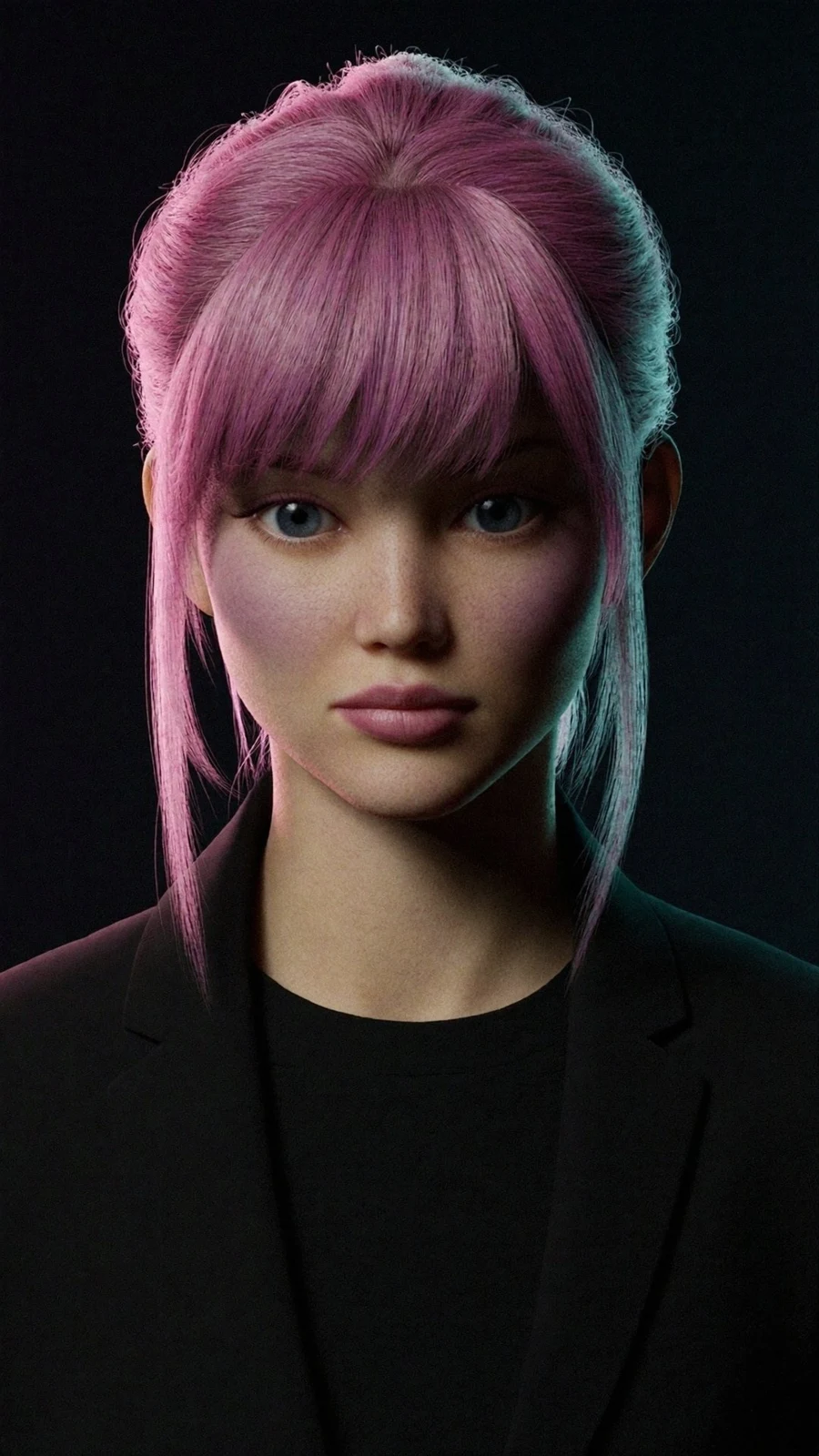
That is the face we set out to build for Aria.
Why start with a face at all
A voice gives words a rhythm. A face gives the conversation a focal point. When you can see who you are talking to, you relax into the exchange a little more. You notice a reaction. You adjust. The conversation becomes something you share, rather than something you send.
But a face can also work against you. A beautiful character who stares blankly while you speak feels less present than a voice on its own. So for us, the face is not decoration. It is part of how Aria takes part in the conversation.
Built in real time, in 3D
Aria is an interactive digital human: a real-time 3D character with a detailed, expressive human face, rendered live as you talk, rather than a pre-recorded clip played back on cue.
Real time is the important part. A pre-recorded face can look lovely, but it cannot react to you. A live face can.
Listening is something you can see
A face that listens is one you can see listening. The moments when Aria is not talking matter as much as the moments when she is.
That is why we pay as much attention to the quiet moments as to the spoken ones. While you speak, her face should stay with you rather than freeze into a mask. Small, quiet movements say "go on, I am following" without a single word.
We think of this as presence. It is the difference between a character who is waiting for a cue and one who is in the room.
A face that listens is one you can see listening.
Expressions that follow the conversation
Conversation has an emotional shape. A funny story, a tricky question and a hard day all deserve different faces.
Aria is designed for conversational presence, micro-expressions and real-time emotional adaptation. In plain words: her expression is meant to move with the conversation, in small and natural steps, rather than snapping between a handful of fixed looks.
Small is the key word. Big, theatrical expressions are easy to make and tiring to watch. The subtle ones, a softening around the eyes, a hint of a smile before a reply, are harder, and they are the ones that make a face feel alive.
Where the eyes go
Eyes do a lot of quiet work in a conversation. They tell you whether someone is paying attention, whether they are thinking, and when they are about to speak.
We treat Aria's eyes as part of the conversation, not as a finishing touch. A face can have every other detail right and still feel distant if the eyes are not with you. It is one of the areas we keep refining.
Timing is part of the face
Even a perfect expression feels wrong if it arrives late. That is why the face and the voice are built around the same idea: real-time conversation with natural interruption.
When you jump in, the conversation is designed to move to you. When it is Aria's turn, she answers out loud while her face carries the reply. Timing is what ties expression, voice and listening into one presence, instead of three separate effects running side by side.
When you let her see you
Listening can go both ways. If you choose to share your camera during a live session, Aria can respond to what you show, and to visible expressions and body language.
That is always your choice. Sharing starts only when you turn it on, and you can stop it at any time. These are automated interpretations, so they can be wrong. And we do not use these images to identify you, create a face print or train AI models.
Always a virtual character
However expressive a face becomes, one thing does not change: Aria is an AI character, not a person. A notice on the startup screen says so at the start of every live session, and again after every three hours of continuous conversation.
We think that clarity makes the experience better, not worse. You can enjoy a character's warmth and timing precisely because you know what she is.
Still listening
A face that listens is never really finished. Every conversation teaches us something about timing, about expression and about what makes a character feel present. We will keep sharing what we learn here.
Curious to see it for yourself? Sign up and have a conversation with Aria.